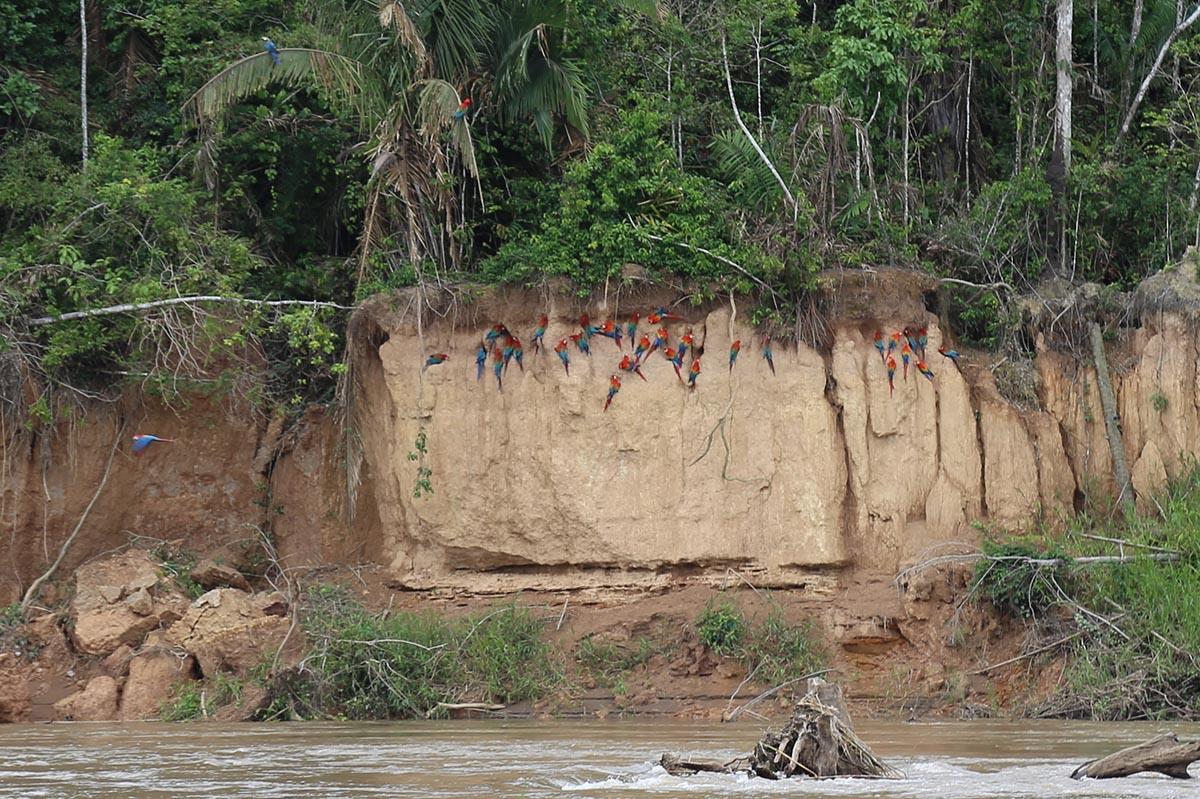
Macaw and parrot clay licks - A highlight among the Amazon’s many attractions
11 January 2018 (9281 visits)For bird lovers, the macaw and parrot clay licks of Tambopata National Reserve are an attraction not to be missed. The spectacle created by the bright plumage and raucous calls of hundreds of birds provides one of the most memorable highlights to any traveler’s visit to the forests of the Amazon basin.
Situated in southeastern Peru, Tambopata National Reserve was created in 1990 as a refuge for what is an incredible diversity of typical Amazon fauna and flora. Today, the National Reserve continues to protect the highest concentration of clay licks in the world.
Known in Peru as a collpa (or colpa), a clay lick is a wall of clay formed as a river’s meander erodes its bank. These walls of clay contain nutrients which are sought avidly by several species of macaws, parrots and parakeets, as well as many other animals.
Experts have proposed a number of theories to explain why macaws and parrots consume clay from riverbanks. Most scientists now agree that these birds seek out such clay deposits for the sodium they contain and to neutralize the toxins present in their diet of seeds and berries. Some species of macaw have been recorded flying up to 100 kilometers across the forests of the Amazon in search of a clay lick.
Whatever the precise reason for this remarkable behavior, there can be no doubt that the resulting spectacle is something all visitors to South America’s Amazon basin should try to see at least once. At major clay licks like those which can be visited in one- or two-day excursions from our Tambopata Ecolodge, around first light parrots and macaws gather, often in groups of several hundred, to feed on the clay, creating an extraordinary display of color and sound.
At these clay licks, parrots usually arrive before macaws. Activity tends to begin just after dawn, with parrots perching in the highest branches of trees, calling out to each other and checking for predators as their numbers grow steadily, before descending en masse to the clay lick.
Guests at our Tambopata Ecolodge can visit two macaw and parrot clay licks in Tambopata National Reserve.
Collpa Chuncho is a major clay lick, attracting several parrot species, among them three species of macaw: the red and green macaw, blue and yellow macaw, and scarlet macaw. This clay lick is around 10 meters (30 feet) high and approximately 400 meters (1300 feet) long. El Gato clay lick is smaller and more readily accessible than Chuncho, attracting the same range of species, although usually in fewer overall numbers.